
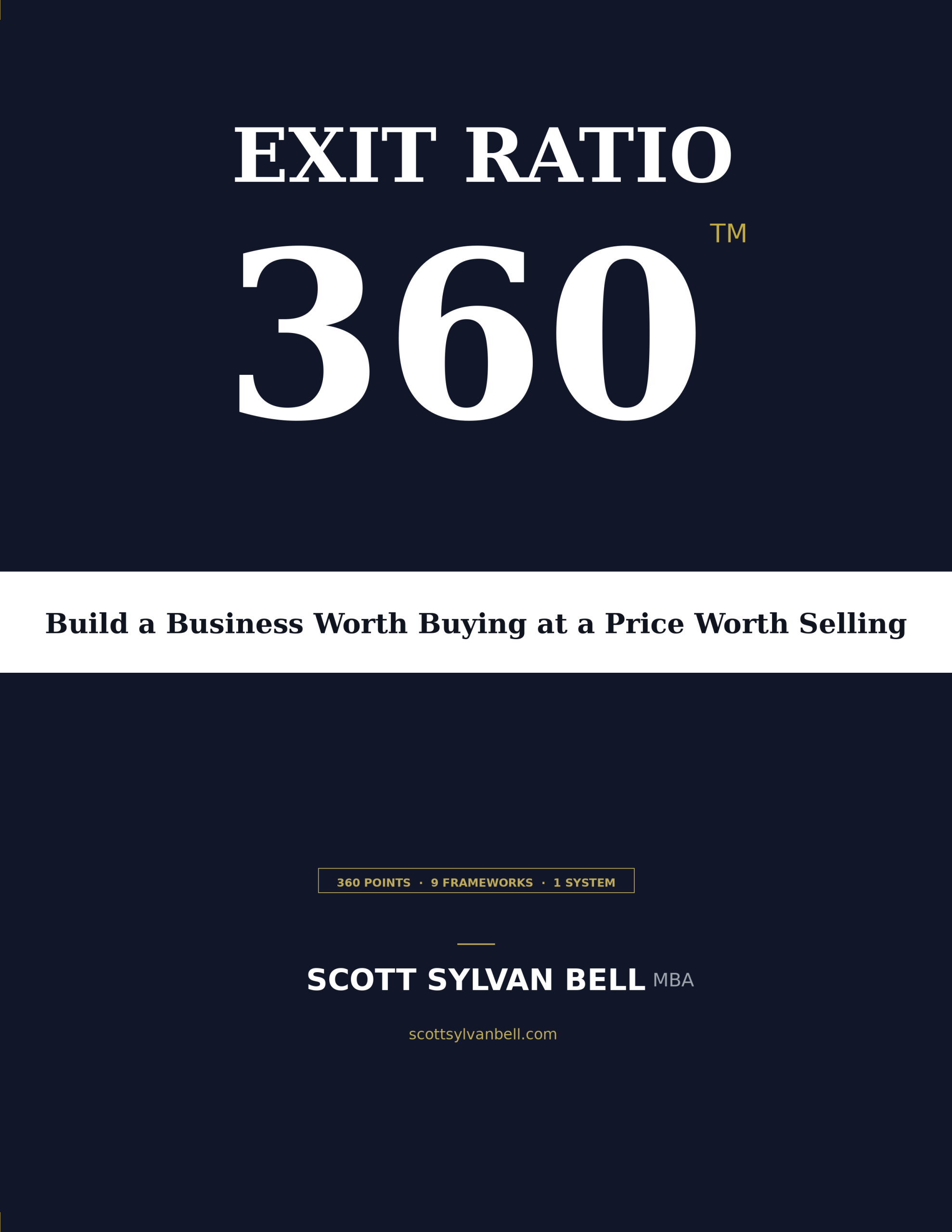
Order Exit Ratio 360™ on Amazon →
Most business owners find out what their company is worth when a buyer tells them. By then it is too late to fix anything. The Exit Ratio 360™ is the scored evaluation that changes that equation — a 360-point system that tells you exactly where your business stands, where value is leaking, and what needs to be addressed before a buyer’s due diligence team finds it for them.
Not a checklist. Not a general impression. A number — scored across nine components — that gives a business owner the same picture a sophisticated buyer has before they make an offer.
The Nine Components of the Exit Ratio 360™
Every business is evaluated across 360 points organized into nine scored components. Each component measures a different dimension of business value and transaction readiness. Together they produce a complete picture of what a buyer sees — and what they will use to justify a lower price or a more complex deal structure.
LAUNCH — How the business was built and what that history signals to a buyer. The foundation. The origin story. Whether the business was built to last or built to run.
SCORE — Financial performance and revenue quality. What the numbers actually show, what they obscure, and how a buyer’s accounting team will normalize them during due diligence.
SELL — The sales process and how revenue is generated. Whether revenue depends on the owner’s relationships or whether it runs through a documented, transferable system.
SCALE — Operational systems and scalability. Whether the business can grow without the owner in the room and absorb additional volume without breaking.
DRIVER — Founder dependency and key person risk. The single most common valuation gap in mid-market businesses. If the business cannot run without the founder, a buyer is pricing that risk into every number on the table.
EXIT — Transaction readiness across the full preparation checklist. Whether the business is ready for the process — legally, financially, operationally — or whether the diligence process will surface problems the owner did not know existed.
BENCH — Management depth and succession. Whether the business has a team that can operate and grow without the founder present — the platform test that separates a platform multiple from a bolt-on multiple.
LEAD — Leadership systems and organizational health. How decisions get made, who makes them, and whether the organization can execute strategy independently of the founder.
THREATS — Competitive vulnerability and market defensibility. What a buyer sees when they look at the market you operate in and evaluate whether your position in it is defensible after the transaction.
What the Score Tells You
The Exit Ratio 360™ evaluation produces a scored picture of exactly where a business stands across all nine components. That score tells an owner three things: where the value is, where it is leaking, and how long each gap takes to close before going to market.
Some gaps close in 90 days. Others — founder dependency, management bench depth, recurring revenue development — require 12 to 24 months of consistent work before a buyer will credit them in the multiple. Knowing which category your gaps fall into tells you exactly how long you need before going to market to capture full value. That timeline starts the day you start the preparation — not the day you decide you want to sell.
The difference between a prepared transaction and an unprepared one at $4M EBITDA is $6M to $8M. That gap is not determined by the broker, the market, or the timing. It is determined by the preparation work that happens before the process starts — and by whether the owner knew what to fix and had time to fix it.
The Book
The Exit Ratio 360™ book walks through every component of the system in full — with composite characters, real-world deal scenarios, and the specific preparation work each component requires. It is written for owners of $10M–$250M companies who want to understand exactly what they have and exactly what it will take to exit at full value.
ISBN: 979-8-9911756-9-2 | Publisher: Aries711 LLC | Price: $49.95
Start With a Half-Day Session
The Exit Ratio 360™ evaluation begins with a half-day consulting session — four hours to identify your most pressing needs, run a preliminary read against all nine components, and determine what the preparation timeline looks like before going to market. No long-term commitment required to have that conversation.
Call or text 808-364-9906 or visit the half-day consulting page.